This is actually what my day was like on Wednesday, but I was up pretty late and too tired to get everything posted yesterday. Not a lot happened yesterday. Nina, my partner, and I went to visit the clinic, Icyuzuzo, in the Nyamirambo district of Kigali that serves a much poorer area of Rwanda. Hard to imagine being any more below the poverty line.
We toured the clinic which consists of two main buildings. One for HIV testing and counseling that also houses a meeting room for large groups. The WE-ACTx clinics are part of an association that all work together to coordinate care along with the national TRAC program. TRAC is the government's agency that focuses on HIV treatment for all Rwandans. The offices were created from one large stone building with sheets of plywood acting as office walls and doors. We then walked past a grassy area where the kids play while they wait and an outdoor toilet, that as far as i can tell is a wall that people walk behind to go to the bathroom. We went into the clinic and met a lot of staff. The women have and outdoor education area that begins a new health related education session each morning at 7/7:30 which lasts about an hour and the patients really seem to like it. They also have a comment/suggestion book that lets the women ask for certain topics to be addressed each day.
There is one doctor for this clinic and three nurses, along with a lab technician (one microscope and some test tubes and blood draw tubes), a pharmacy tech, and many trauma counselors. Too often, the trauma counselors outnumber the rest of the staff. The clinic is clean and nicely organized. The doctor sees patients with difficult cases, those that need prescriptions and referrals, and anyone starting Antiretrovirals (ARVs) for HIV. The nursing staff is given a lot of opportunity to treat patients in a way that physicians do. This clinic truly would not survive without the fabulous nursing staff! On a busy day 80 patients are seen and no one is ever turned away. Dr. JMV sees every patient that comes to the clinic each day. It is even open on Mondays when he is at a rural clinic in the association, and on Wednesday and Friday mornings when he is at meetings for TB and pediatrics cases in the mornings. He is such a nice man and I look forward to talking with him and learning from him. Odette is by far my favorite staff member because she greeted us with hugs and kisses on the cheek. (How very French indeed!)
After our tour, Nina and I went back to the clinic and went fabric shopping with the other interns. I bought some fabulous fabrics, including very lightweight Tanzanian cloth. All of the colors are so bright! I think the clothes I'm having made will turn out very nice.
Later Nina and I worked on finishing our ARV survey and focus group stuff and just relaxed a little. Truthfully, we were pretty psyched about our new fabric and spent about an hour planning clothes. We do get to have some playtime here.
So I feel I should say a word about the food here, seeing as that is the first question my mother asks me each conversation I have with her online. Seriously. Every time. We have excellent cooks at the WE-ACTx house, Seraphine and Candida. There is a lot of rice and potatoes. Our main dishes include fish and tofu, which actually does taste just like chicken if prepared correctly. I really can't describe the sauces except to say they're nothing like I've ever tasted before and incredibly yummy. Each night also includes a vegetable mix with sauce. For lunch it's peanut butter sandwiches all the way with the best PB I've ever had! Breakfast is usually toast or oats, which are good too, like bigger pieces of oatmeal. I'm going to attempt eggs for breakfast this weekend and hopefully I'll learn how to make crepes. We also have delicious spinach/broccoli soup puree and homemade french fries! The hills are a rough climb so I'm sure I'll come back a little lighter.
P.S. Dad I ate my vegetables, now go get your damn colonoscopy. I'm holding you to the deal!
Moose

Thursday, June 7, 2007

Tuesday, June 5, 2007
Day Two: the most amazing day ever, and it's only day two!!
Today I woke up early and went to the clinic. I talked a lot along the way with Mary, a psychologist who works with torture victims seeking political asylum in the US. She's been giving me the ins and outs of Eastern Africa all day today. Trips are in the planning stages...
Anyway, at the clinic I finally met Simon who's the financial director of WE-ACTx and we talked about the project I'm doing with my partner, Nina, who's a med student from Northwestern. We'll be giving out questionnaires and conducting small focus groups with HIV+ women who are eligible to be on medication, most of whom are, but we're looking at medicinal regimen compliance and what factors contribute to why these women might be inconsistent with taking their medications. (minus 2 points for a run-on sentence.) Another project I was encouraged to design/work on is a pilot module for sex ed for adolescent girls and boys and discuss some of the cultural issues that we see happening here. The kids that are enrolled and seen at WE-ACTx are amazing kids that have access to a great deal of staff members who are fabulously kind and generous with their love and time. Part of the problem is that the girls face a much different reality than some of the boys and they don't feel comfortable talking in front of them and some of the male counselors. For example, another intern found out a few weeks ago that many of the adolescent girls are prostituting themselves for money for their families as suggested by their mothers who, at one time, were also prostitutes. These girls also reported very young sexual experiences with their boyfriends and talked about familial sexual abuse. Clearly these girls will not be able to prevent sexual abuse in many cases, but there are things they can do to protect themselves from getting additional strains of the HIV virus. So, I'll be searching (While God's greatest gift was love, google comes in a very close second) for modules that were used elsewhere and then presenting them as a pilot and having it translated to the girls. After the session, we're all going to talk about what can be changed, what they already knew, what questions they would like to see answered in it. We're truly hoping that the young Rwandans will help open up the dialog about sexual practices and HIV in this country, especially with respect to family planning.
This afternoon I went attended a support group for women who have children who are HIV positive. All of the mothers that attend are positive as well, which is how most of the children got it. There was one grandmother there that pulled out a photograph of her and her grandchildren to show us all of them, I think 8 total. Leave it to Grandma's to bust out the pictures! (Hi Grandma!) A couple of topics came up today and everything was translated for the interns so we could comment, ask questions, and contribute. We started with breast feeding and the risk of passing HIV on to the babies, because two mothers had infants with them today (Cutest babies ever!) We talked about their fears, alternative solutions, and other mothers gave advice. The problem with this is that, while many women have access to drugs to reduce the chances of mother-to-child transmission at birth, this does not extend to breast milk after birth. The of HIV infection through breast milk is about 10%, which is very significant. So the easy solution would be to say, stop breast feeding. Well, that's nice but then they'd starve or die of terrible dysentery. The water supply is not clean enough to use to mix with formula and normally children receive antibodies from their mothers during breast feeding and naturally from within their own bodies as they grow. These antibodies help fight off some diseases found in the water and help keep them strong so that they can avoid a serious case. Oftentimes, the water supply is so dirty that cholera and other diseases claim the lives of a large percentage of young children. So again, it comes down to the economics of poverty.
Another woman told us her story and the group leader and herself asked my opinion. She was a prostitute and became HIV+ to support her family when her husband was trying to find work and eventually passed it to her child. She didn't tell him this, but there were rumors in her neighborhood that she was HIV+ along with her child. She is no longer living with her husband and they both love each other and he wants her to stay with him, but she feels ashamed returning to his house, and doesn't want anymore children to be born HIV+. She never told him her serostatus herself and asked me what I thought she should do. She also added that she feared if she told him, he would hurt her and her child, but she doesn't want to lie. Umm......So I told her we should be concerned with her safety and her child's safety first and possibly set up counseling with the husband if she felt she absolutely had to tell him. We're going to discuss the topic of disclosure more next week.
The stories were amazingly difficult. These women also expressed that they were so open to sharing with us because they like the mzungo's connected to WE-ACTx and knew that we loved them and would help them. I felt so small. I looked at them and memorized their faces. They are tired, but still unbelievably strong.
As we were leaving the neighborhood young children probably no more than four years old ran up to us and pulled on my skirt to come play with them. They fought over which one could hold my hands and were giving me high-fives along the way. Looking around these people have nothing. They are living in shacks built with metal slabs for roofs that just lay over the top of their stone wall house, barely attached. Poverty is such an avalanche for these women. There are so many issues that greatly and deeply affect them that can be prevented, like finding clean water sources by installing wells with simple water purification technologies. There is a lot of listening, talking, and teaching that needs to be done here. The cycle of cultural stoicism needs to be broken down with respect to HIV and people need to feel comfortable talking about it and their sexual health.
I'm only going to post a few of my pictures because the internet here is very slow and hard to get them all on the blog, but I'll be putting them on facebook for all my friends that have it!
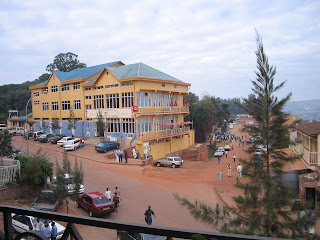
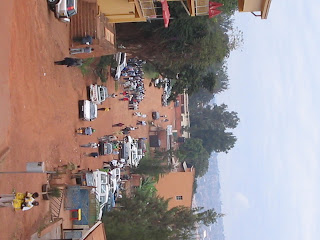
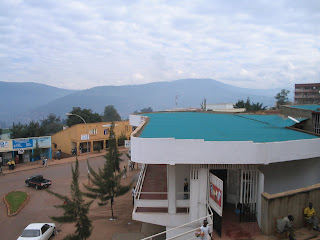
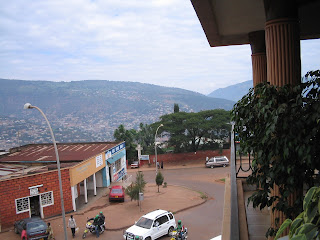
These are just some shots of Kigali from the balcony of the clinic: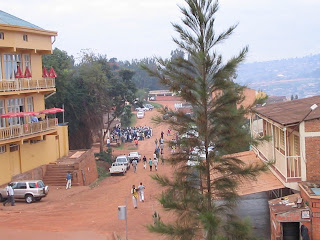


Anyway, at the clinic I finally met Simon who's the financial director of WE-ACTx and we talked about the project I'm doing with my partner, Nina, who's a med student from Northwestern. We'll be giving out questionnaires and conducting small focus groups with HIV+ women who are eligible to be on medication, most of whom are, but we're looking at medicinal regimen compliance and what factors contribute to why these women might be inconsistent with taking their medications. (minus 2 points for a run-on sentence.) Another project I was encouraged to design/work on is a pilot module for sex ed for adolescent girls and boys and discuss some of the cultural issues that we see happening here. The kids that are enrolled and seen at WE-ACTx are amazing kids that have access to a great deal of staff members who are fabulously kind and generous with their love and time. Part of the problem is that the girls face a much different reality than some of the boys and they don't feel comfortable talking in front of them and some of the male counselors. For example, another intern found out a few weeks ago that many of the adolescent girls are prostituting themselves for money for their families as suggested by their mothers who, at one time, were also prostitutes. These girls also reported very young sexual experiences with their boyfriends and talked about familial sexual abuse. Clearly these girls will not be able to prevent sexual abuse in many cases, but there are things they can do to protect themselves from getting additional strains of the HIV virus. So, I'll be searching (While God's greatest gift was love, google comes in a very close second) for modules that were used elsewhere and then presenting them as a pilot and having it translated to the girls. After the session, we're all going to talk about what can be changed, what they already knew, what questions they would like to see answered in it. We're truly hoping that the young Rwandans will help open up the dialog about sexual practices and HIV in this country, especially with respect to family planning.
This afternoon I went attended a support group for women who have children who are HIV positive. All of the mothers that attend are positive as well, which is how most of the children got it. There was one grandmother there that pulled out a photograph of her and her grandchildren to show us all of them, I think 8 total. Leave it to Grandma's to bust out the pictures! (Hi Grandma!) A couple of topics came up today and everything was translated for the interns so we could comment, ask questions, and contribute. We started with breast feeding and the risk of passing HIV on to the babies, because two mothers had infants with them today (Cutest babies ever!) We talked about their fears, alternative solutions, and other mothers gave advice. The problem with this is that, while many women have access to drugs to reduce the chances of mother-to-child transmission at birth, this does not extend to breast milk after birth. The of HIV infection through breast milk is about 10%, which is very significant. So the easy solution would be to say, stop breast feeding. Well, that's nice but then they'd starve or die of terrible dysentery. The water supply is not clean enough to use to mix with formula and normally children receive antibodies from their mothers during breast feeding and naturally from within their own bodies as they grow. These antibodies help fight off some diseases found in the water and help keep them strong so that they can avoid a serious case. Oftentimes, the water supply is so dirty that cholera and other diseases claim the lives of a large percentage of young children. So again, it comes down to the economics of poverty.
Another woman told us her story and the group leader and herself asked my opinion. She was a prostitute and became HIV+ to support her family when her husband was trying to find work and eventually passed it to her child. She didn't tell him this, but there were rumors in her neighborhood that she was HIV+ along with her child. She is no longer living with her husband and they both love each other and he wants her to stay with him, but she feels ashamed returning to his house, and doesn't want anymore children to be born HIV+. She never told him her serostatus herself and asked me what I thought she should do. She also added that she feared if she told him, he would hurt her and her child, but she doesn't want to lie. Umm......So I told her we should be concerned with her safety and her child's safety first and possibly set up counseling with the husband if she felt she absolutely had to tell him. We're going to discuss the topic of disclosure more next week.
The stories were amazingly difficult. These women also expressed that they were so open to sharing with us because they like the mzungo's connected to WE-ACTx and knew that we loved them and would help them. I felt so small. I looked at them and memorized their faces. They are tired, but still unbelievably strong.
As we were leaving the neighborhood young children probably no more than four years old ran up to us and pulled on my skirt to come play with them. They fought over which one could hold my hands and were giving me high-fives along the way. Looking around these people have nothing. They are living in shacks built with metal slabs for roofs that just lay over the top of their stone wall house, barely attached. Poverty is such an avalanche for these women. There are so many issues that greatly and deeply affect them that can be prevented, like finding clean water sources by installing wells with simple water purification technologies. There is a lot of listening, talking, and teaching that needs to be done here. The cycle of cultural stoicism needs to be broken down with respect to HIV and people need to feel comfortable talking about it and their sexual health.
I'm only going to post a few of my pictures because the internet here is very slow and hard to get them all on the blog, but I'll be putting them on facebook for all my friends that have it!
These are just some shots of Kigali from the balcony of the clinic:


Monday, June 4, 2007
This is the story of how I almost died 8 times
So the legend goes that there was a girl from the midwest that is used to crossing the streets in a large city. She always looks both ways, then does the double look in the first direction she looked just to be sure a car didn't sneak up on her while she was looking in the opposite direction. She's never even been close to being hit by a car, motorcycle, or various mode of transportation...until now...::Flash to the present:: Kigali, the capital city of Rwanda. While traffic drives on the right side of the road, not like the crazies in the rest of the world...::shameless fun poking, don't be alarmed::...anyway, I digress. So the cars and stupid moto's (motor bikes) are zooming everywhere and decide when there are traffic signs, they exist solely as pretty wilderness decorations, nothing to be followed as rules or anything. Most of the streets en route to the clinic don't have lines, so as you can imagine it's a free-for-all. Anyway, I was peacefully walking along today, and yesterday, minding my own business, looking at the million new things there are for me to see, and a bunch of cars almost hit me. Like 8 times. They were going really fast. I actually, honest--this is not a joke or a made up story to make me look good, but I actually pulled a little boy out of the way of a psychotic minibus that would have hit him and me if we didn't move. Surprise, Surprise, motor vehicles hitting pedestrians is a huge problem in Rwanda leading to fatalities, so much so that the government was inspired to put in raised sidewalks. Good idea. Except they're not in by the clinic so it was no help to me as I wandered dangerously close to cars flying around everywhere.
I know what you're thinking, "Melanie, you're supposed to walk opposite the direction of traffic". Thanks. That would be great advice to follow if traffic went in two different directions and stayed in their respective lanes. Something to get used to.
Today I stood on the clinic's balcony and watched. I...watched...everything. The mechanic taking the hub caps off old tires, the woman selling phone cards waived to me, the young man selling women's shoes on the street (none of them matching), and the women carrying babies in a sack on their back. I really think this is the way to go. Never have I seen happier children. The people here are so friendly, but they are a very stoic people. It is said that it is impossible to tell what a Rwandan is thinking. Generally, I've found people to open up to me with just a smile. For me, not being able to speak the language, body language and non-verbal communication have become crucial in bonding with the Rwandan people I meet. Today at the clinic I used the bathroom and started to walk back upstairs when a woman in a bright blue apron stopped me and started speaking French to me. I quickly told her I didn't understand, with the confused look on my face at which point she took me by the hand, guided me back to the areas with the washroom and started to pat her chest. She held up a key for the men's bathroom and made a motion of putting the key in the lock and turning it. Now I know, without one word, that there is in fact a staff bathroom, and that this woman has the key. Amazing. Today was kind of a simple day because my partner didn't arrive until after clinic time and then we hashed out the details of the projects we'll be doing. I will be going back tomorrow and going fabric shopping to have some clothes made for me. I'm also still working on the pictures.
I know what you're thinking, "Melanie, you're supposed to walk opposite the direction of traffic". Thanks. That would be great advice to follow if traffic went in two different directions and stayed in their respective lanes. Something to get used to.
Today I stood on the clinic's balcony and watched. I...watched...everything. The mechanic taking the hub caps off old tires, the woman selling phone cards waived to me, the young man selling women's shoes on the street (none of them matching), and the women carrying babies in a sack on their back. I really think this is the way to go. Never have I seen happier children. The people here are so friendly, but they are a very stoic people. It is said that it is impossible to tell what a Rwandan is thinking. Generally, I've found people to open up to me with just a smile. For me, not being able to speak the language, body language and non-verbal communication have become crucial in bonding with the Rwandan people I meet. Today at the clinic I used the bathroom and started to walk back upstairs when a woman in a bright blue apron stopped me and started speaking French to me. I quickly told her I didn't understand, with the confused look on my face at which point she took me by the hand, guided me back to the areas with the washroom and started to pat her chest. She held up a key for the men's bathroom and made a motion of putting the key in the lock and turning it. Now I know, without one word, that there is in fact a staff bathroom, and that this woman has the key. Amazing. Today was kind of a simple day because my partner didn't arrive until after clinic time and then we hashed out the details of the projects we'll be doing. I will be going back tomorrow and going fabric shopping to have some clothes made for me. I'm also still working on the pictures.
Sunday, June 3, 2007
Two Faced
I can't help but write a bit more after talking with another intern, Margot. We talked about how beautiful the country is, how surprisingly normal, how seemingly ordinary. The Rwanda I see when I close my eyes involves screaming, explosions, gun fire, blood soaked machetes. I can hear the scenes from Hotel Rwanda in my head. When I open my eyes, the genocide is gone. I cannot tell a Hutu from a Tutsi, I cannot tell who killed, I cannot tell who fled. I can't even see a reflection of the genocide in the population numbers. The destruction of the poor areas in Kigali looks like the social consequences of being poor, not a result of genocide.
This is what really seeing is all about. The amputees on crutches got their limbs hacked off by machetes. The people with scars across the backs of their ankles, they had their Achilles Tendon slashed to prevent them from fleeing. The Hutus would cut this tendon and then try to get back to kill the wounded later. The wounded Tutsi can only flee as fast as his arms can drag his own bloody body. Many people here have large, disfiguring scars all over their limbs--again, machetes. Where are the people who caused this? The people who killed? Who aided the killers? They're in the big black flat bed trucks wearing the bright pink uniforms. Prisoners who were found guilty for having a role in the genocide. There they are in a truck going down the street. The punishment for these people reflects a desire for the country to heal: the Hutu killers must do volunteer work to build houses for the remaining Tutsis. The pink jumpsuit is their work uniform.
I listened to an excellent PRI (see NPR) special podcast on Rwanda before coming here in which the killers were interviewed about their current thoughts on their deeds and Rwandan officials discussed the punishments chosen for them. Are the Hutu Power individuals truly sorry? Some claim the killers are simply admitting their roles and apologizing because they know they will be given volunteer sentences and pardoned. Rwandan officials are juggling between punishment and forgiveness, hatred and love, justice and revenge. This country craves peace, but how do you reach that goal when no punishment is equal to the taking of all those lives? How do you love your enemy? How do you simply forgive? Tutsis are mixed about this as, many would expect. Some feel a life for a life, others feel there was no sense in the genocide, so there will be no perfect punishment. There will not be peace here until there is forgiveness. There will not be forgiveness until the victims can finally find peace in their own hearts, not until the victims can lay down their anger. I don't know how someone goes about doing that.
This is what really seeing is all about. The amputees on crutches got their limbs hacked off by machetes. The people with scars across the backs of their ankles, they had their Achilles Tendon slashed to prevent them from fleeing. The Hutus would cut this tendon and then try to get back to kill the wounded later. The wounded Tutsi can only flee as fast as his arms can drag his own bloody body. Many people here have large, disfiguring scars all over their limbs--again, machetes. Where are the people who caused this? The people who killed? Who aided the killers? They're in the big black flat bed trucks wearing the bright pink uniforms. Prisoners who were found guilty for having a role in the genocide. There they are in a truck going down the street. The punishment for these people reflects a desire for the country to heal: the Hutu killers must do volunteer work to build houses for the remaining Tutsis. The pink jumpsuit is their work uniform.
I listened to an excellent PRI (see NPR) special podcast on Rwanda before coming here in which the killers were interviewed about their current thoughts on their deeds and Rwandan officials discussed the punishments chosen for them. Are the Hutu Power individuals truly sorry? Some claim the killers are simply admitting their roles and apologizing because they know they will be given volunteer sentences and pardoned. Rwandan officials are juggling between punishment and forgiveness, hatred and love, justice and revenge. This country craves peace, but how do you reach that goal when no punishment is equal to the taking of all those lives? How do you love your enemy? How do you simply forgive? Tutsis are mixed about this as, many would expect. Some feel a life for a life, others feel there was no sense in the genocide, so there will be no perfect punishment. There will not be peace here until there is forgiveness. There will not be forgiveness until the victims can finally find peace in their own hearts, not until the victims can lay down their anger. I don't know how someone goes about doing that.
Finally Here
I'm here! I slept like a bum in London's airport, laying out on the benches, on my backpack, for 15 hours. The woman checking me in at O'Hare and in London told me to make sure Ethiopia didn't lose my bags, which, I'm delighted to say, they did not! But i was pretty lucky because I had about 20 mins to get to the next flight, so I definitely didn't have the time. But I showed up in Kigali, and so did all my MedSend supplies and my personal stuff, but my ride was late...very late...so late I was in a near panic, as I'm not trained to use the telephone system. The man at the immigration counter chit-chatted with me very politely and wished me luck. The new yellow dufflebags received many compliments throughout the airport and from my new house mates. Back to being temporarily abandoned...I walked past a row of people with name placards...nothing. I go outside and wait. A man walks up to me, well many men walked up to me as one of the only white people there, looking lost, all offering taxi services. A Rwandan police officer walked past, "Hello, sister". This is the way people greet me here. I showed him the address of the WE-ACTx house, which was pointless because no one knew WE-ACTx by that name, and the goal of the house is to keep the community from hounding the staff, so of course this would not be helpful (apparently taxi drivers don't recognize the address system either). He explained to me the nuances of using a phone that required purchasing a great deal of equipment, so needless to say the situation was intense and I was too cheap, so I took a big leap of faith and SURPRISE! Rebecca showed up with our driver, yay!!
Riding back to the house was breathtaking, the hills, the houses, the people.
The interns and I attempted to go to the market and I had my first ride in a minibus. 30 cents a ride. Long story short, market closed, terrace coffee place closed, so we ended up in a streetside bar drinking this awesome African Tea that's very creamy milk with some cane sugar and spices. Very good. Getting home took forever, b/c there's not so much a line at the return minibus stop as there is an angry mob (one that most certainly doesn't like cutters).
And now, for a little more of the less mundane:
The staring hit me the second I got off the plane. It's not as if Rwandan's haven't seen muzungo's (non-africans) before, it's just that we're rare. The last time white people seemed to care about them almost one million Rwandans were wiped out. It's a very intense stare, as if the voyeur were trying to memorize my face. This happens everywhere I go. Everywhere. Put five white girls together and cars start to honk. And they did. And being white here makes it much easier to find a cab too, not shocking after living in Chicago. I don't feel that they're looking at my color so much as my features, the way I dress, and listening to the sound of my voice. Every time I speak they laugh a little. I know what you're thinking, 'what stupid thing did you say to them?' Just ordering tea in the bar/restaurant was an interesting interaction with the staff. The man giggled nervously every time anyone of us said anything. As we sat and drank our tea, we commented on the surprising music choice playing in the background a mixture of 90s pop and current US hits. Shakira is big here. How can one country have such a cultural impact and yet, not act to influence the history of Rwanda?
The history of this country shows in the streets. There is an incredibly large number of amputees walking with the aid of crutches and children follow us every place we go, begging for money, food, or miscellaneous other objects, like pens. They're all wearing American clothes with famous cartoon characters on them, most likely donated by someone in the US. So these kids are clothed, well for now. Essentially, they've been given a band-aid and this of course, will only be a temporary fix. There are so many temporary fixes here, so much charity. Very little justice.
Riding back to the house was breathtaking, the hills, the houses, the people.
The interns and I attempted to go to the market and I had my first ride in a minibus. 30 cents a ride. Long story short, market closed, terrace coffee place closed, so we ended up in a streetside bar drinking this awesome African Tea that's very creamy milk with some cane sugar and spices. Very good. Getting home took forever, b/c there's not so much a line at the return minibus stop as there is an angry mob (one that most certainly doesn't like cutters).
And now, for a little more of the less mundane:
The staring hit me the second I got off the plane. It's not as if Rwandan's haven't seen muzungo's (non-africans) before, it's just that we're rare. The last time white people seemed to care about them almost one million Rwandans were wiped out. It's a very intense stare, as if the voyeur were trying to memorize my face. This happens everywhere I go. Everywhere. Put five white girls together and cars start to honk. And they did. And being white here makes it much easier to find a cab too, not shocking after living in Chicago. I don't feel that they're looking at my color so much as my features, the way I dress, and listening to the sound of my voice. Every time I speak they laugh a little. I know what you're thinking, 'what stupid thing did you say to them?' Just ordering tea in the bar/restaurant was an interesting interaction with the staff. The man giggled nervously every time anyone of us said anything. As we sat and drank our tea, we commented on the surprising music choice playing in the background a mixture of 90s pop and current US hits. Shakira is big here. How can one country have such a cultural impact and yet, not act to influence the history of Rwanda?
The history of this country shows in the streets. There is an incredibly large number of amputees walking with the aid of crutches and children follow us every place we go, begging for money, food, or miscellaneous other objects, like pens. They're all wearing American clothes with famous cartoon characters on them, most likely donated by someone in the US. So these kids are clothed, well for now. Essentially, they've been given a band-aid and this of course, will only be a temporary fix. There are so many temporary fixes here, so much charity. Very little justice.
Thursday, May 31, 2007
Contact Info for the Future
I leave tomorrow! Wow! Fortunately for my sanity (and phone bill) my phone won't be making the journey with me, so email me if you need to reach me. If for some reason you need to speak to me personally, you should direct your calls to my secretary for the summer, Mom, or my personal representative, Dad. Email me for their home number. Feel free to email me, but I may not be able to get back to everyone and let's face it, this is my last free summer, so I may choose to ignore you. Just kidding Mom.
Email: melanieandrews72@hotmail.com
Email: melanieandrews72@hotmail.com
Wednesday, May 30, 2007
Just something to think about
A friend gave me this quote before my first ABI Service trip at Loyola. It most definitely applies for this trip too, well any service for that matter.
Everywhere in the world people are in search of love, for everyone is convinced that love alone can save the world, love alone can make life meaningul and worth living. But how very few understand what love really is, and how it arises in the human heart. It is so frequently equated with good feelings toward others, with benevolence or nonviolence or service. But these things in themselves are not love. Love springs from awareness. It is only inasmuch as you see someone as he or she really is here and now and not as they are in your memory or your desire or in your imagination or projection that you can truly love them, otherwise it is not the person that you love but the idea that you have formed of this person, or this person as the object of your desire not as he or she is in themselves.
Therefore the first act of love is to see this person or this object, this reality as it truly is. And this involves the enormous discipline of dropping your desires, your prejudices, your memories, your projections, your selective way of looking, a discipline so great that most people would rather plunge headlong into good actions and service than submit to the burning fire of this asceticism. When you set out to serve someone whom you have not taken the trouble to see, are you meeting that person's need or your own? So the first ingredient of love is to really see the other...It is in that act of seeing that love is born, or rather more accurately, that act of seeing is Love.
-Anthony De Mello SJ, The Way to Love
In Paul Farmer's book, Pathologies of Power, he writes that one of his goals is to bear witness to the sufferings and needs of those he cares for. This is my goal for the trip, to return and tell people of the things as they truly are in Rwanda. No rosey hue, no sugar coating. I hope that I can approach this trip without preconceived notions, a lofty goal I know, but important for me to attempt. As a second year medical student, I have not begun to care for patients, so listening to their stories and challenging myself to explore outside my comfort zone is crucial if I am to be useful to these people in any way.
Everywhere in the world people are in search of love, for everyone is convinced that love alone can save the world, love alone can make life meaningul and worth living. But how very few understand what love really is, and how it arises in the human heart. It is so frequently equated with good feelings toward others, with benevolence or nonviolence or service. But these things in themselves are not love. Love springs from awareness. It is only inasmuch as you see someone as he or she really is here and now and not as they are in your memory or your desire or in your imagination or projection that you can truly love them, otherwise it is not the person that you love but the idea that you have formed of this person, or this person as the object of your desire not as he or she is in themselves.
Therefore the first act of love is to see this person or this object, this reality as it truly is. And this involves the enormous discipline of dropping your desires, your prejudices, your memories, your projections, your selective way of looking, a discipline so great that most people would rather plunge headlong into good actions and service than submit to the burning fire of this asceticism. When you set out to serve someone whom you have not taken the trouble to see, are you meeting that person's need or your own? So the first ingredient of love is to really see the other...It is in that act of seeing that love is born, or rather more accurately, that act of seeing is Love.
-Anthony De Mello SJ, The Way to Love
In Paul Farmer's book, Pathologies of Power, he writes that one of his goals is to bear witness to the sufferings and needs of those he cares for. This is my goal for the trip, to return and tell people of the things as they truly are in Rwanda. No rosey hue, no sugar coating. I hope that I can approach this trip without preconceived notions, a lofty goal I know, but important for me to attempt. As a second year medical student, I have not begun to care for patients, so listening to their stories and challenging myself to explore outside my comfort zone is crucial if I am to be useful to these people in any way.
Subscribe to:
Posts (Atom)